037 — Trained PING tolerates 80% drops but only 15% adds (trains)
Abstract
Perturbs the hidden spike stream of trained PING and COBA networks at inference (drop spikes, add spikes) to ask whether the PING rate floor is dynamical or informational. PING tolerates ≈80% drop but only ≈15% add before accuracy collapses; COBA is roughly flat to both perturbations. The asymmetry — drops forgiven, adds break the gating — is the gamma cycle made visible: a structural feature of the architecture, not a readout-side trade-off.
Methods
Training recipe (canonical / medium tier):
| Parameter | Value |
|---|---|
| Integration timestep | 0.1 ms |
| Trial duration | 200 ms |
| MNIST samples (80/20 stratified split of 2000) | 1600 train / 400 test ( 2.9% of the 70k-sample MNIST corpus) |
| Epochs | 10 |
PING and COBA baseline definitions and training recipe are in nb025; the rate-floor mechanism is worked out in nb025. This entry tests whether the floor is dynamical (locked by the cycle period) or informational (locked by the readout’s spike-count requirement) by perturbing the spike stream of trained networks at inference.
Results
Hidden-spike perturbation
The mechanism is a per-step callback installed on the COBANet’s _hidden_perturb_fn slot.
When the callback fires. Every timestep of every trial. No warm-up, no schedule, no exclusion. Trials are ms at ms → 2000 fires per trial. Test set ≈400 trials → ≈800 000 fires per (model, mode, level) sweep point against the same trained network. Level is constant across all timesteps and trials at a given sweep point.
Where in the step body. At each timestep :
- update conductances from the previous step’s spikes: , with the analogous update for from and the E→I conductance from ;
- LIF step integrates from and emits raw spike vectors , ;
- perturbation callback rewrites the raw vectors → ;
- record the perturbed vectors into the spike buffer;
- readout accumulator adds to the mem-mean integrator.
Step 1 of timestep consumes and through , , . A dropped E spike at fails to drive I at and contributes nothing to the readout at . An injected I spike at adds inhibition at and counts in the rate metric. E and I get the same mode and level with independent draws.
In drop mode, for each (batch, neuron, timestep) slot draw i.i.d.:
Each emitted spike is kept with probability ; silent slots stay silent. Drop reduces the spike count fed to both the readout and the next-step conductance update, while leaving the E→I→E feedback loop intact. Sweep , 11 levels.
In add mode, for each slot draw i.i.d.:
At ms, Hz gives a per-step extra-spike probability of . The clamp is for binary cleanliness — the process is Bernoulli, not additive integer. Silent slots become 1 with probability . Add injects spikes at Poisson statistics independent of cycle phase. Sweep Hz, 21 levels.
The per-step RNG is a CPU torch.Generator seeded at EVAL_SEED + 1, separate from the input encoder so the Poisson input stream matches the unperturbed baseline. Total: 2 models × (11 drop + 21 add) = 64 forward passes.
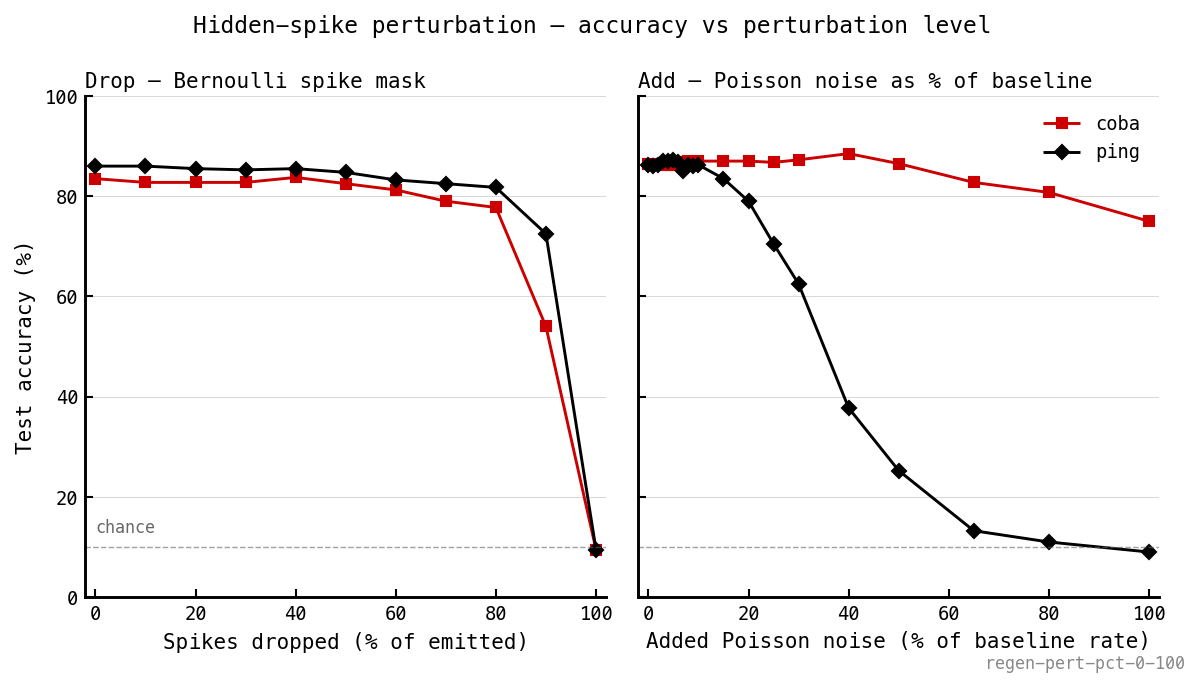
Left (drop): Bernoulli mask, % of emitted spikes dropped. Right (add): Poisson noise injection at and — independent draws for E and I, each population scaled by its own baseline rate so the comparison is architecture-fair. Baselines used (30-epoch single-seed): COBA Hz; PING Hz, Hz. The asymmetry is now visible directly: PING tolerates drop up to ≈ 80% but collapses on add between 15% and 50% relative noise, while COBA stays at 75% even with 100% extra Poisson.
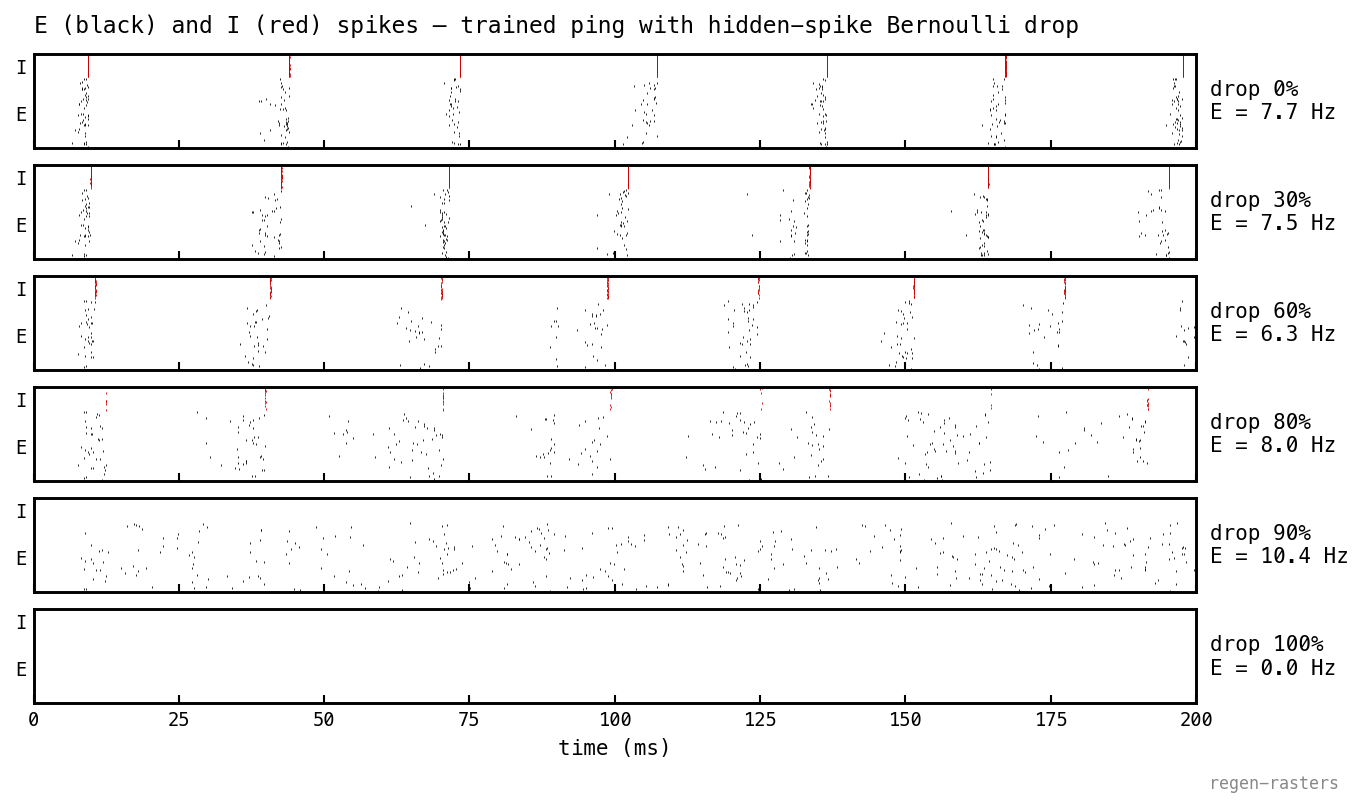
Trained PING replayed on the same MNIST digit 0 trial across the six drop levels sampled in Figure 1’s left panel (0, 30, 60, 80, 90, 100%); E (black) above I (red) per panel. The gamma cadence persists across all sub-total levels — dropped spikes thin the train without injecting phase-incoherent activity.
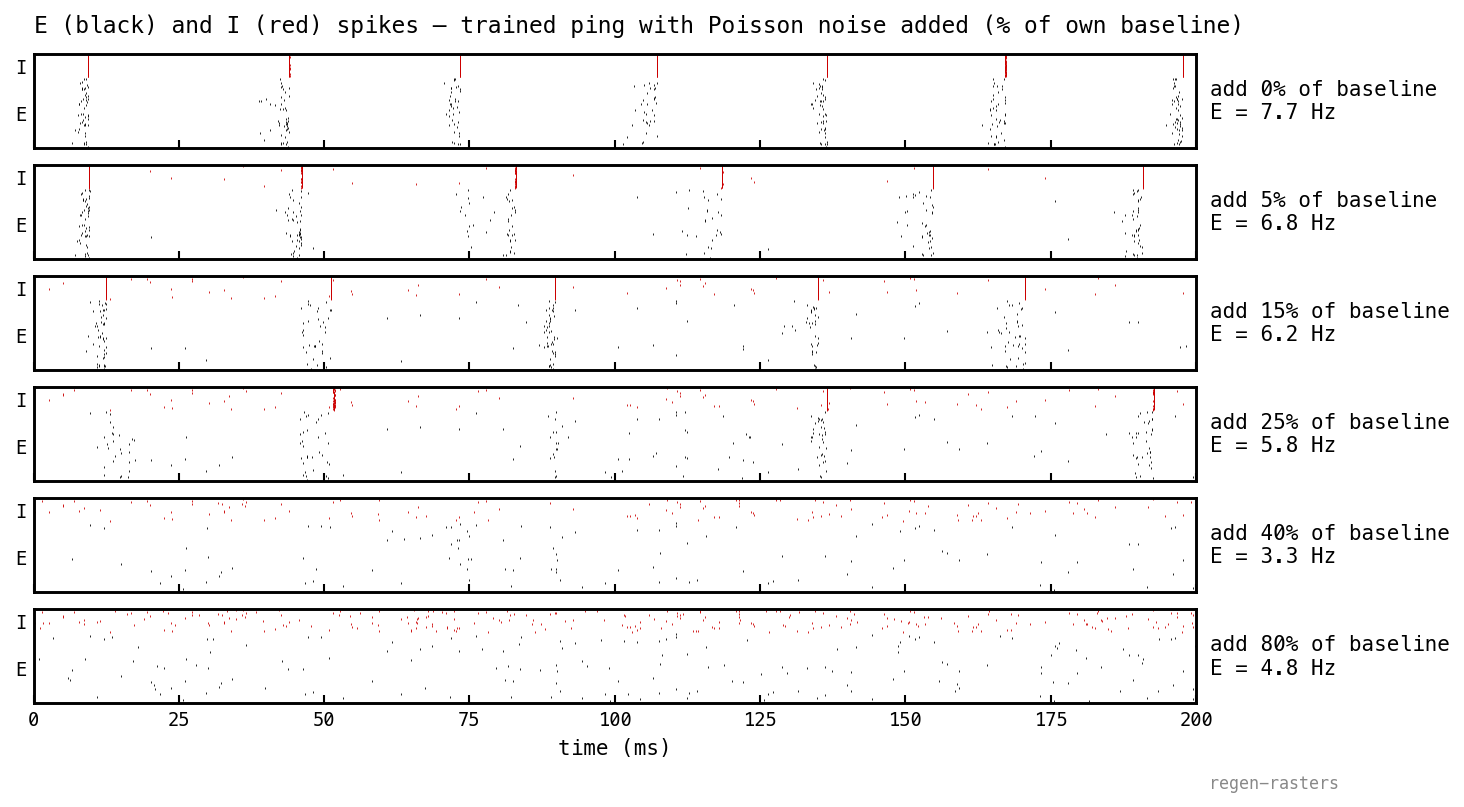
Trained PING replayed across the six pct-of-baseline add levels sampled in Figure 1’s right panel (0, 5, 15, 25, 40, 80%), with and per population. The cycle visibly dissolves across 25–40%, matching Figure 1’s accuracy cliff.
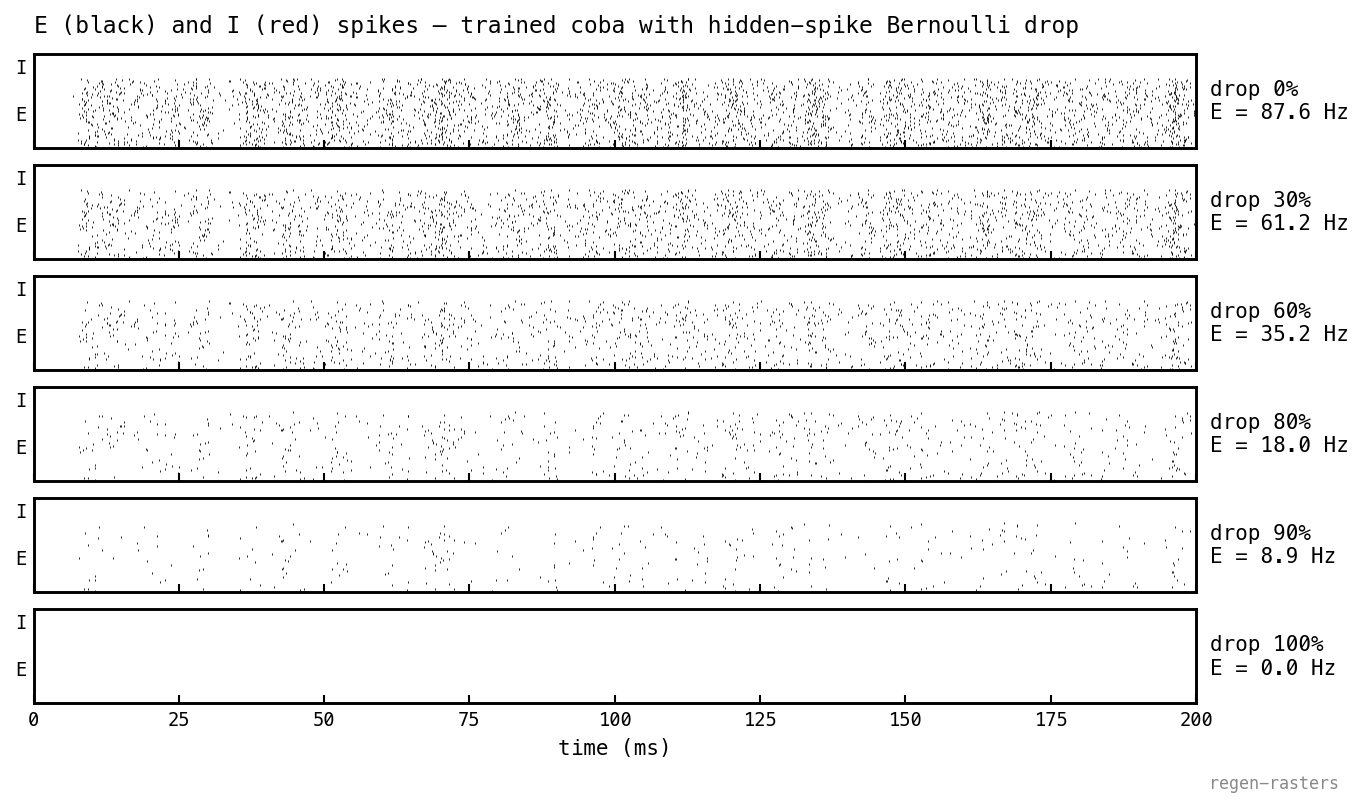
Trained COBA replayed across the same drop sweep as Figure 2. With no cycle to preserve, dropping spikes just thins a uniform asynchronous mean.
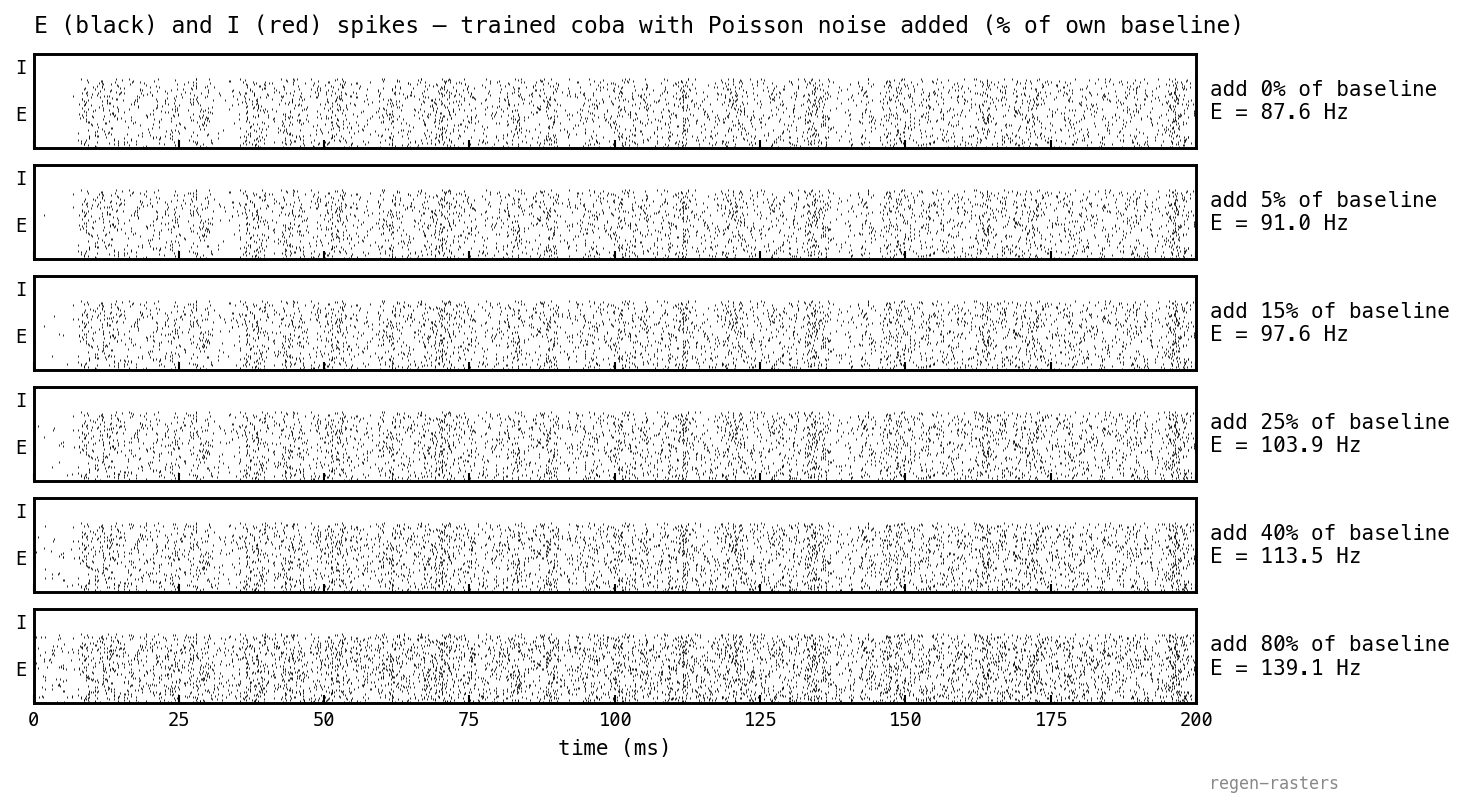
Trained COBA replayed across the same pct-of-baseline add sweep as Figure 3. Added spikes blend into COBA’s asynchronous mean — no temporal structure to corrupt, just a higher mean rate.
Drop and add are asymmetric. Under drop, PING holds 72.5% at through I-loop compensation: fewer E spikes drive I less, GABA relaxes, and E fires more freely. The recorded E rate rises to ≈7 Hz at and remains near 5 Hz at — back-calculating, the pre-drop rate at that point is ≈49 Hz (≈90% discarded), approaching COBA’s spontaneous level. The E→I→E loop compensates because it is weakened proportionally rather than phase-corrupted.
Per-population scaling on the right panel
Figure 1’s right panel expresses Poisson noise as a percentage of each architecture’s own baseline rate, with E and I scaled independently by their own baselines. The fair-comparison fix matters: an earlier version of this figure used absolute Hz for both architectures, but baselines differ by an order of magnitude (COBA E ≈ 65 Hz vs PING E ≈ 6 Hz), so “10 Hz of injected noise” was 15% of COBA’s rate but 170% of PING’s. Per-population scaling restores apples-to-apples.
| pct of baseline | PING acc | PING | COBA acc | COBA |
|---|---|---|---|---|
| 0% | 86.3% | 5.88 Hz | 86.5% | 65.08 Hz |
| 5% | 87.3% | 5.50 Hz | 86.3% | 68.32 Hz |
| 10% | 86.3% | 5.10 Hz | 87.0% | 71.56 Hz |
| 15% | 83.5% | 4.50 Hz | 87.0% | 74.79 Hz |
| 20% | 79.0% | 3.87 Hz | 87.0% | 78.02 Hz |
| 25% | 70.5% | 3.28 Hz | 86.8% | 81.26 Hz |
| 30% | 62.5% | 2.87 Hz | 87.3% | 84.49 Hz |
| 40% | 37.8% | 2.72 Hz | 88.5% | 90.95 Hz |
| 50% | 25.3% | 3.07 Hz | 86.5% | 97.42 Hz |
| 65% | 13.3% | 3.85 Hz | 82.8% | 107.10 Hz |
| 80% | 11.0% | 4.72 Hz | 80.8% | 116.81 Hz |
| 100% | 9.0% | 5.89 Hz | 75.0% | 129.75 Hz |
The 0–10% subrange (sampled in 1% steps) confirms both architectures are robust to small relative perturbations — the cycle structure tolerates ≤ 10% phase-incoherent additions without degrading readout. The 15–50% range shows the PING cliff: a sharp accuracy fall from 84% to 25%, where the added I spikes corrupt the cycle’s temporal structure faster than the I-loop can compensate. COBA is essentially flat across the same range — without a cycle to corrupt, added spikes just raise its mean E rate without breaking readout.
Two structural observations from the wide sweep:
- PING’s E rate is non-monotonic. It drops 5.88 → 2.72 Hz across 0–40% pct as added I noise suppresses E firing, then rises back to 5.89 Hz at 100% as the cycle fully dissolves and E fires randomly under the broken loop. The minimum at 40% coincides with the steepest accuracy drop.
- COBA’s E rate climbs monotonically to ≈ 130 Hz at 100% pct — the added noise is directly entering the mean firing rate without architectural feedback.
So the original “drops forgiven, additions break the gating” claim is right and now visible on a fair axis: PING tolerates 80% drop but only ≈ 15% add before the cycle starts breaking, and reaches chance by 65% add. COBA is robust to both perturbations at the level of readout (though its E rate naturally tracks added noise).
Discussion
The combined picture: drop preserves the cycle and is compensated; add corrupts the cycle and collapses accuracy. The rate floor is the gamma cycle made visible — a structural feature of the architecture, not an accuracy/spike-count tradeoff the readout could otherwise navigate.
Next steps
- Repeat the add sweep with the added I spikes phase-locked to the cycle (vs the current incoherent Poisson) and confirm the cliff softens when the perturbation respects the rhythm.
- Extend to the COBA arm with a paired drop+add of equal expected spike count, to isolate whether COBA’s robustness is from rate insensitivity or from spike-pattern insensitivity.