038 — Switching the loop on at inference cuts E rate ≈10× (trains)
Abstract
Loads a trained COBA network and switches the I-loop on at inference by sweeping ei_strength from 0 to 1. The same feedforward weights that fire at ≈52 Hz without the loop fire at ≈5 Hz with the loop engaged, and accuracy stays within ≈12 pp of the COBA baseline. PING gating is a post-hoc sparsity knob — the architecture, not the training, supplies the gamma dynamics.
Methods
Training recipe (canonical / medium tier):
| Parameter | Value |
|---|---|
| Integration timestep | 0.1 ms |
| Trial duration | 200 ms |
| MNIST samples (80/20 stratified split of 2000) | 1600 train / 400 test ( 2.9% of the 70k-sample MNIST corpus) |
| Epochs | 10 |
PING and COBA baseline definitions and training recipe are in nb025. This entry runs the COBA → PING I-loop transfer probe at eval time on the trained baselines. The input-rate sweep / f-I curve material that previously lived here has moved to nb023, which is the natural home for “architectural response to drive” content.
Results
COBA → PING I-loop transfer
Inference-only: the trained COBA baseline (seed 42, off) is loaded and ei_strength is overridden at eval time across 11 values from 0 to 1. and load from the COBA checkpoint; and are freshly initialised (the COBA checkpoint has these at zero, so skipping the load preserves a functional I-loop). No retraining.
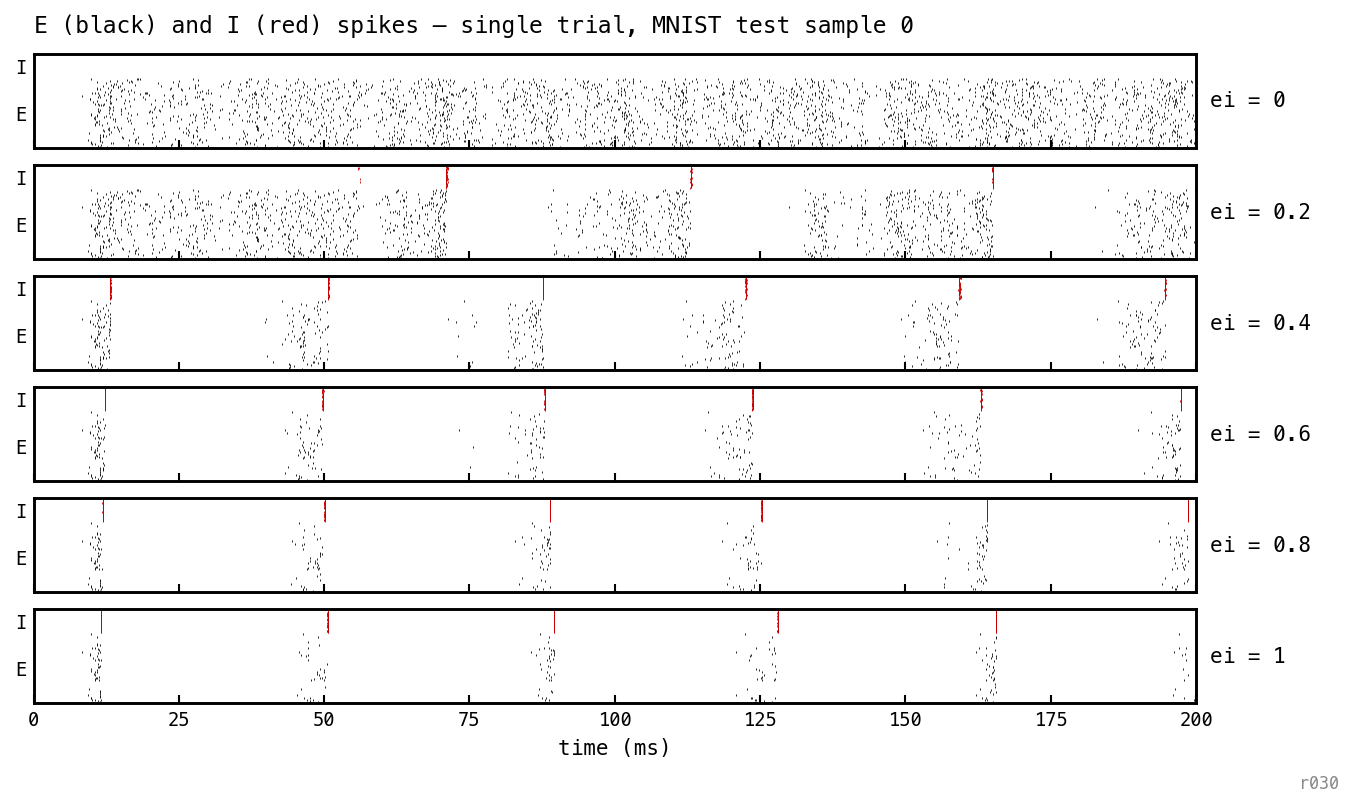
Trained COBA replayed at six inference-time ei_strength values; same trial, same weights, fresh I-loop each row.
At ei = 0 the asynchronous-dense COBA pattern persists. By ei ≈ 0.4 the same feedforward weights produce gamma cycles. The PING dynamics come from the inhibitory architecture, not from training — the same weights that fired at 52 Hz without the loop fire at ≈5 Hz with the loop wired up.
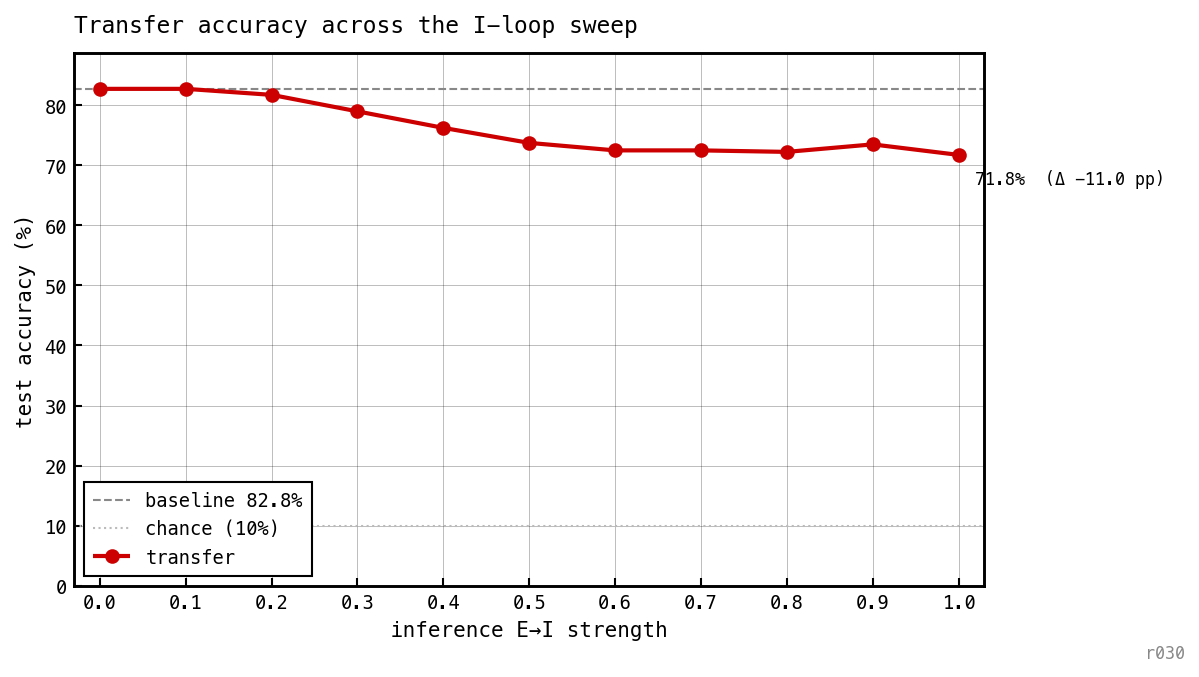
Test accuracy vs inference-time ei_strength on trained COBA weights.
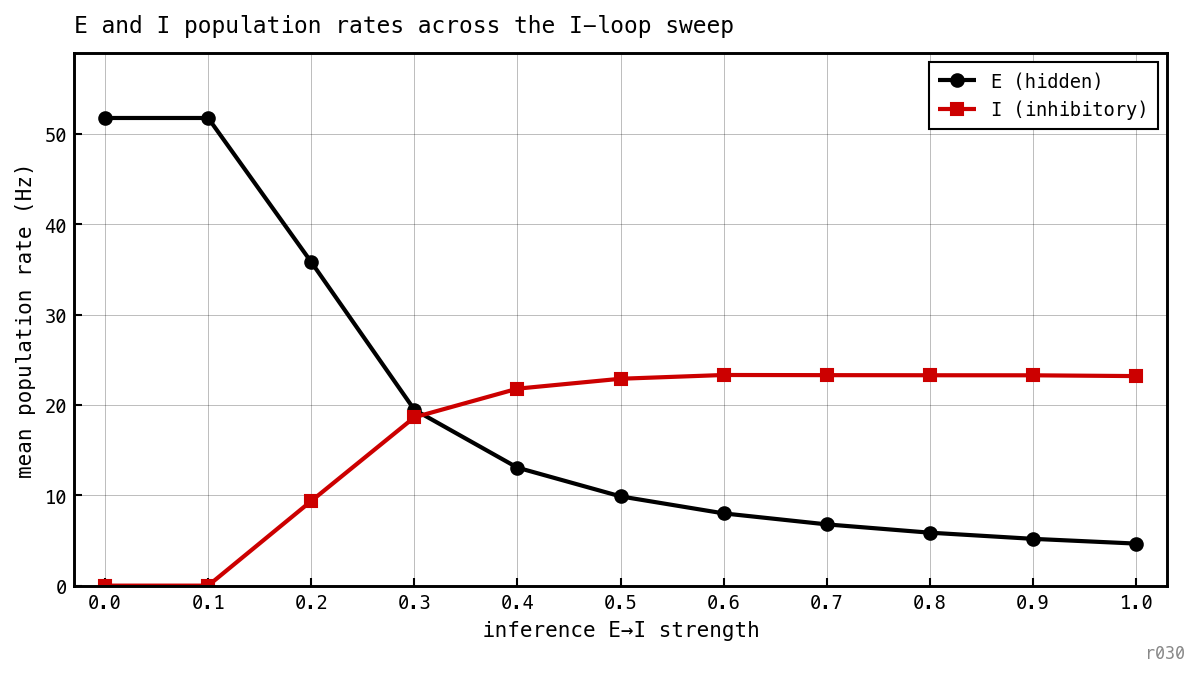
Mean E and I rates across the same ei_strength sweep.
Accuracy stays within ≈12 pp of the COBA baseline across the full ei_strength range. E rate falls monotonically from ≈52 Hz (ei = 0) to ≈5 Hz (ei = 1); I rate rises from zero to ≈23 Hz. Suppression is continuous in the loop strength.
Discussion
The I-loop transfers cleanly onto COBA-trained weights: switching on at inference time compresses the E rate by an order of magnitude with a bounded accuracy cost. The PING substrate is therefore not contingent on having been trained with the loop engaged — it can be added post-hoc as a sparsity knob.
Next steps
- Repeat the transfer in the opposite direction: train with the I-loop on, then sweep ei_strength down to zero at inference. Symmetric collapse would confirm the loop is a sparsity knob rather than a learned-circuit property.
- Quantify the accuracy/rate Pareto frontier traced by the ei_strength sweep and compare to the per-architecture frontier from nb025.